
UK study visa changes affecting applicants in 2026
Introduction
The UK immigration policies are constantly changing, shaped by economic factors, political priorities, and migration trends. There are five major changes that directly affect international students applying for study visas in 2026. Increased visa fees, higher maintenance requirements, restrictions on certain nationalities, the rollout of digital eVisas, and shorter post-study stays for most graduates are some of these developments.
Understanding these policy changes is crucial for future and incoming international students interested in studying in the UK, as careful planning, timely applications and realistic financial preparation can make the difference between a smooth transition and unexpected challenges. This article highlights five key changes and explains what applicants must know to prepare effectively for their UK study journey.
UK study visa fees increase from 8 Apr 2026
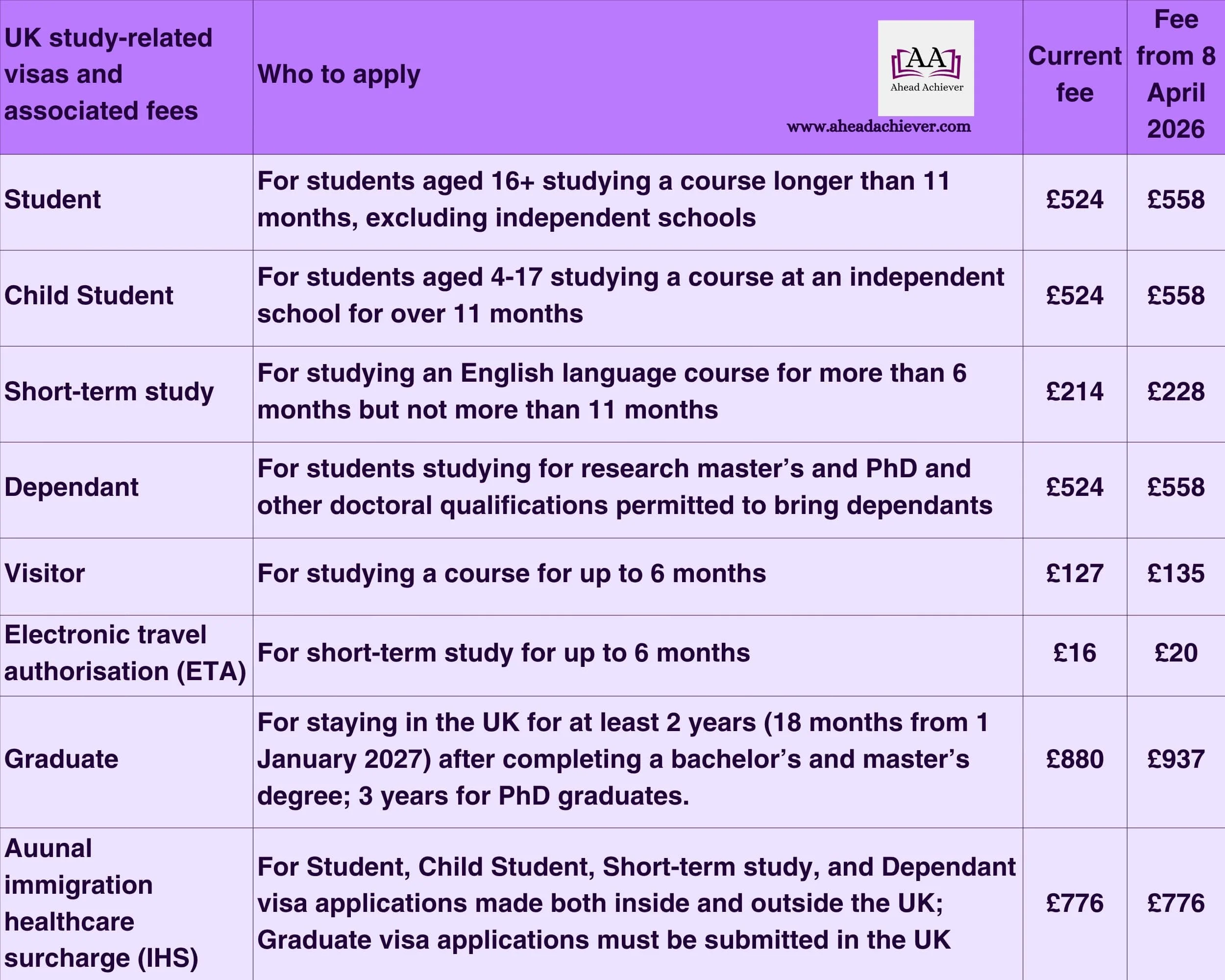
According to the latest immigration and nationality fees published by the Home Office on 18 March 2026, the increased UK study visa fees for international students will become effective on or after 8 April 2026 (GOV.UK, 2026a). Study-related visas and associated fees, such as Student, Child Student, Short-term study, Dependant, Visitor, and Graduate visas, as well as electronic travel authorisation (ETA), will increase by about 6% to 7%. The annual immigration healthcare surcharge (IHS) remains unchanged.
✹ Student visa (for students aged 16+ studying a course longer than 11 months, excluding independent schools): The fee will rise from £524 to £558.
✹ Child Student visa (for students aged 4–17 studying a course at an independent school for over 11 months): The fee will rise from £524 to £558.
✹ Short-term study visa (for studying an English language course for more than 6 months but not more than 11 months): The fee will rise from £214 to £228.
✹ Dependant visa (for students studying for research master’s and PhD and other doctoral qualifications permitted to bring dependants): The fee will rise from £524 to £558.
✹ Visitor visa (for studying a course for up to 6 months): The fee will rise from £127 to £135.
✹ Electronic travel authorisation (ETA) (for short-term study for up to 6 months): The fee will rise from £16 to £20.
✹ Graduate visa (for staying in the UK for at least 2 years (18 months from 1 January 2027) after completing a bachelor’s and master’s degree; 3 years for PhD graduates): The fee will rise from £880 to £937.
✹ Immigration healthcare surcharge (IHS) (for Student, Child Student, Short-term study, and Dependant visa applications made both inside and outside the UK; Graduate visa applications must be submitted in the UK): The annual fee remains £776.
Note: Fees for Student, Child Student, Short-term study, and Dependant visas are the same whether applied for inside or outside the UK.
Table 1. UK study-related visas and associated fees increase from 8 April 2026
Sources: GOV.UK (2026a); GOV.UK (no date – a); GOV.UK (no date – b).
International students are advised to prepare for these periodic increases (typically announced in March and effective in April each year) and submit their visa applications before the new April fees take effect to save money. To do so, they will need to apply for their master’s course as early as possible to receive an offer and Confirmation of Acceptance for Studies (CAS) in time.
Higher maintenance requirements from 11 Nov 2025
The Home Office announced an increase in the monthly maintenance funds required for new Student and Child Student visa applicants. From 11 November 2025, students studying in London must demonstrate funds of £1,529 per month (up from £1,334) for up to 9 months, while those studying outside London must show £1,171 per month (up from £1,023) for up to 9 months (GOV.UK, no date – a; GOV.UK, no date – c). The change reflects rising living costs and aims to ensure that incoming international students have enough funds to support themselves while studying in the UK.
You do not need to provide financial evidence if you have been in the UK for at least 12 months with a valid visa prior to the date of your student visa application, or if you are from a country listed under the “differential evidence requirement” (GOV.UK, no date – a; GOV.UK, no date – c).
Study visa ban: Afghanistan, Cameroon, Myanmar, and Sudan from 26 Mar 2026
The UK Home Secretary announced in early March 2026 that access to student visas for four nationalities would be suspended; from 26 March 2026, student visa applications for passport holders from Afghanistan, Cameroon, Myanmar, and Sudan are automatically denied (GOV.UK, 2026b). This decision follows a 470% rise in asylum applications from students of these four nationalities between 2021 and 2025, making them among the most likely nationalities to claim asylum in the UK.
Additionally, the number of Afghans on work visas seeking asylum has now surpassed the number of issued visas. As a result, new Skilled Worker visa applications from Afghan nationals are refused from 26 March 2026 (GOV.UK, 2026b).
These stringent measures are implemented in response to a significant increase in asylum claims from legal routes, which have more than trebled since 2021, with 133,760 people claiming asylum after arriving in the UK legally in the past 5 years (GOV.UK, 2026b).
eVisa transition for study visas from 15 Jul 2025
UK Visa and Immigration (UKVI) has been gradually replacing physical immigration documents with a digital record of your identity and immigration status since 2018, known as an eVisa through the UKVI account (GOV.UK, 2026c). To date, millions of people have already received eVisas. From 15 July 2025, UKVI began replacing Biometric Residence Permits (BRPs) and vignette stickers previously placed in passports with eVisas for study and work visa applicants. And then from 30 October 2025, the change extended to dependants, and to those applying for family and settlement visas (GOV.UK, 2026c).
As a UK study visa holder, you will need to create a UKVI account to access your eVisa. After registration, you will be able to view your identity and your immigration status (i.e. your eVisa) through this account. You will also be able to get a share code to prove your immigration status with other organisations, such as universities, landlords, and employers (GOV.UK, no date – d).
Graduate visa shortened to 18 months from 1 Jan 2027
The UK government will reduce post-study durations from 2 years to 18 months for most graduates to lower net migration, effective from 1 January 2027 (GOV.UK, no date – b; UK Parliament, 2026). Graduate visa holders will only be able to stay in the UK for 18 months to look for work after completing their bachelor’s and master’s degrees (both taught and research master’s degrees). Therefore, if your Graduate visa application is made on or after 1 January 2027, you will have six months less to secure employment or switch to other visa categories, such as the Skilled Worker visa. Graduates with a PhD or other doctoral qualifications remain unaffected, meaning they can still have 3 years of post-study work rights (UK Parliament, 2026).
Conclusion
Study visa applicants in 2026 face several changes, including visa fees, maintenance funds, country‑specific bans, the eVisa rollout, and the graduate visa duration. Staying informed, acting promptly, and seeking professional guidance can help them make strategic decisions, avoid unnecessary costs, and ensure their applications are accurate and aligned with the latest immigration rules. Ultimately, success will depend not only on academic achievement but also on how well students adapt to the changing immigration environment in the UK.
Reference list of UK study visa changes affecting applicants in 2026
Get guidance with Ahead Achiever. Our British Council Certified Counsellors stay up to date on the latest immigration rules. Contact us today for help with your UK student visa application.
