
The 12 Week Year: Book summary and favourite quotes
Table of contents
Book summary
The 12 Week Year, written by Moran and Lennington (2013), changes our perspective on achieving our goals from a year to a 12-week time frame. A year-long time frame mistakenly makes people think there is plenty of time left in the year to make things happen. However, a sense of urgency is critical to prompting us to act. When the time frame is reduced from a year to 12 weeks, people realise that every week is vital and every day is crucial to accomplishing what they are capable of. Moreover, such shorter periodisation, as demonstrated in Olympic training in the 1970s, maximised capacity in each skill when only focusing on one skill at a time for a limited period. Once the 12 weeks end, you take a break, celebrate, recharge, and, most importantly, reflect on the past 12 weeks to better achieve your following 12 Week Year goals.
The book’s primary purpose is to teach people the “how-to” or “process” for executing plans, driving results, and reaching their full potential. According to the authors, the significant difference between successful and unsuccessful people is a lack of consistent execution rather than a lack of knowledge. Not by working harder but by concentrating on essential activities, maintaining a sense of urgency to complete important things, and letting go of low-value activities that keep you stuck.
Eight elements encompass five disciplines, and three principles are fundamental to high performance in the 12 Week Year execution system. The five disciplines are vision, planning, process control, measurement, and time use, while the three principles are accountability, commitment, and greatness in the moment (Moran and Lennington, 2013). In a nutshell, the 12 Week Year is about setting one to three goals and four to five tactics for each goal to be executed within 12 weeks. It shortens your execution cycle from one year to 12 weeks. The plan should not include everything you do in your job, but only the strategic items. Setting the deadline to 12 weeks rather than 12 months gives people a sense of urgency to work because there is nothing like a deadline to get you motivated.
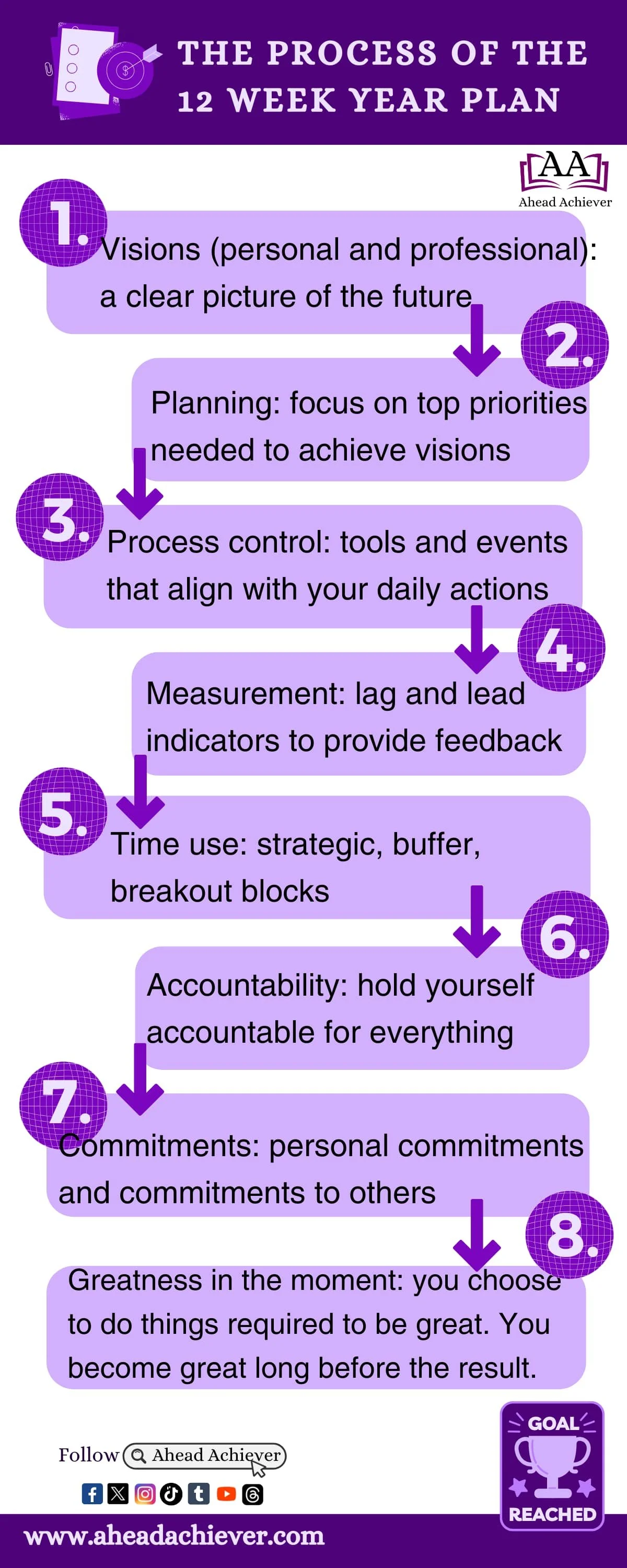
The process of the 12 Week Year plan
Step 1. Vision
It is a clear picture of the future, including personal and business or career visions. Consider your visions over the long term, three years, and 12 weeks. Personal visions are about what you desire to live, have strong emotions attached to them, and should be larger than the current vision. Business or career visions should be developed in light of your personal visions. Your vision is the driver of your goals.
Step 2. Planning
Turn your visions into 12-week goals and focus on the top priorities to achieve your business or career visions. Planning reduces stress, saves time, and allows for greater focus. First, identify one to three things that impact you most, then set one to three goals (e.g., lose 10 pounds) and their respective tactics (e.g., go to the gym three times a week). Tactics must be specific and actionable, with a deadline and responsibility assigned. Spend five minutes at the beginning of each day reviewing your weekly plan and planning for that day’s activities. Spend 15 to 20 minutes at the start of each week reviewing the previous week and planning the following week.
Step 3. Process control
A set of tools and events that align with your daily actions to keep you on track, such as weekly plans, peer support, and a weekly accountability meeting (WAM). These tools and events ensure you spend more time on strategic and profit-generating activities.
Step 4. Measurement
Use lag and lead indicators to provide comprehensive feedback. The lag indicator represents the end result (e.g., losing 10 pounds), whereas the lead indicator represents the process (e.g., going to the gym thrice weekly). It would be excellent if you could complete 85% of your planned tasks. Spend 15 to 20 minutes at the beginning of each week reviewing and scoring the previous week, planning the next week, and participating in the weekly accountability meeting (WAM).
Step 5. Time use
If you do not have control over your time, you are not in control of your results. There are three ways to intentionally block your time to plan your actions for the week.
a. Strategic block: at least 3 hours a week for important work.
b. Buffer block: 30 minutes to 2 hours each day for low-value activities.
c. Breakout block: 3 hours off work each day.
Step 6. Accountability
Hold yourself accountable for everything, and be willing to accept responsibility for your actions and results.
Step 7. Commitment
Include both personal commitments and commitments to others. Commitment differs from interest because it is a personal promise made to yourself. Spiritual, physical, personal, and business commitments are all examples of personal commitments. Commitments to others can include love relationships, family, community, business, etc. There are four keys: strong desired end results, keystone actions (focus on core activities), costs (require sacrifice), and acting on commitments (even when you do not feel like it).
Step 8. Greatness in the moment
Greatness occurs in the moment you choose to do things required to be great. Having the discipline to stick to doing the difficult things in the moment will pay off later when you are tempted to do more comfortable (but less important) things instead. Thereby, you become great long before you achieve great results. You are most effective when you are mentally where you are physically, or when you are present in the moment. Life happens in the moment, life is lived in the moment, and greatness is ultimately created in the moment.
Our top 10 favourite quotes from the book
“Knowledge is only powerful if you use it, if you act on it.”
“The most powerful visions address and align your personal aspirations with your professional dreams.”
“Vision has the power to enable one to confront and conquer fears, take bold consistent action, and live a life of significance.”
“Freedom of choice is the foundation of accountability.”
“Life balance is not about equal time in each area. Life balance is more about intentional imbalance.”
“A good plan today is better than a perfect plan tomorrow.”
“The only things you can control are the way you think and act, everything else, you can try to influence.”
“The barrier standing between you and the life you are capable of living is a lack of consistent execution.”
“It is human nature that we behave differently when a deadline approaches.”
“People earning $1,000,000 per year are not working 10 times harder than people earning $100,000. In fact, they are sometimes working less, but they are working DIFFERENTLY.”
Reference
Moran, B. P. and Lennington, M. (2013) The 12 week year: Get more done in 12 weeks than others do in 12 months. New Jersey: John Wiley & Sons.
Achieving your academic and professional goals requires both clarity and structure. Ahead Achiever provides exactly that. Book An Hour Consultation for personalised guidance, plan long‑term with our Year At A Glance Calendar, and stay on track with our 12 Week Year Plan. Take control of your future—start right now.
Related article
How do you set meaningful goals and actually achieve them?
